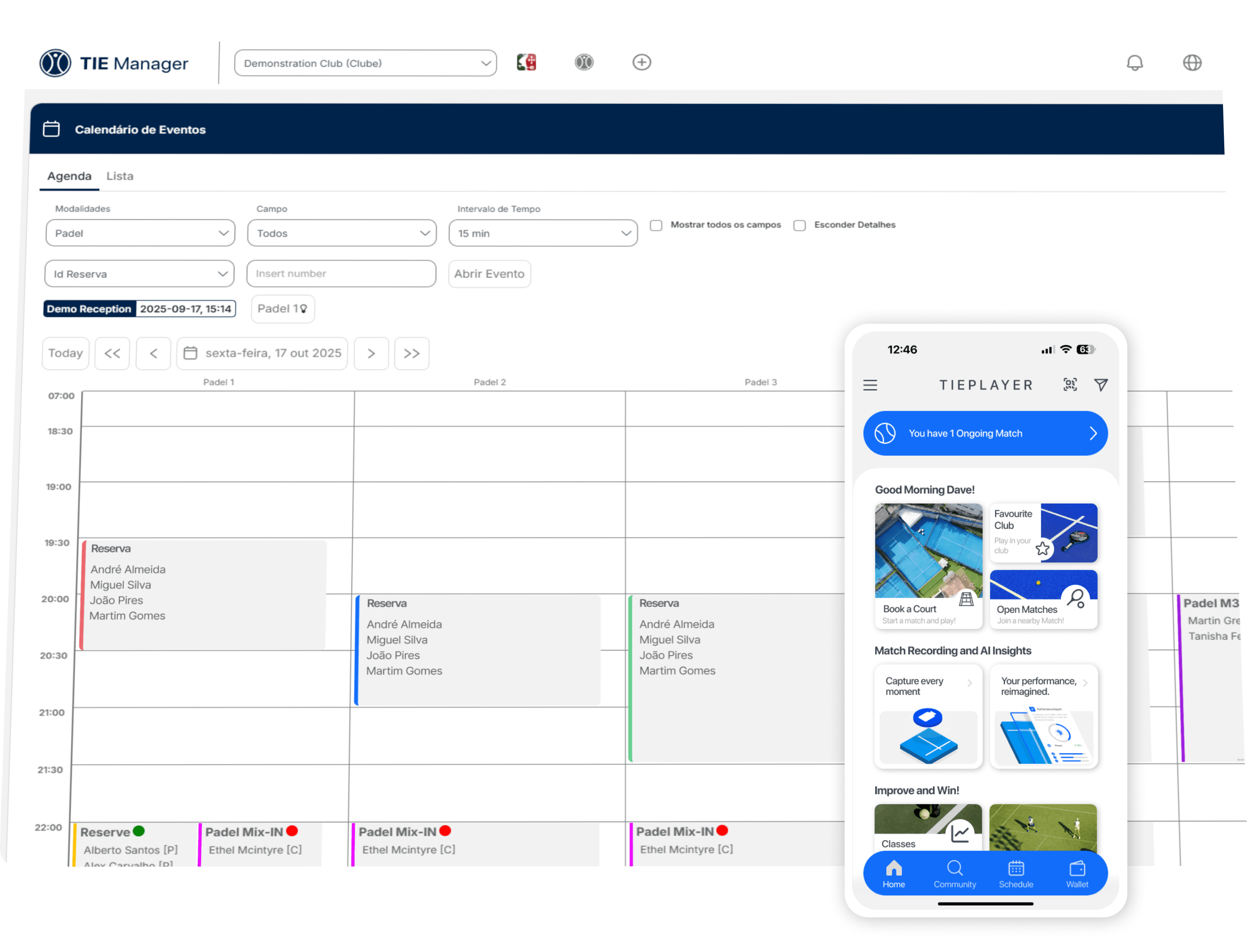
How to choose booking software for a padel or tennis club

Online bookings are only the beginning. Learn what to look for in a platform to simplify payments, reduce administrative work and support your club as it grows.
Choosing booking software means choosing much more than a calendar
At first glance, the purpose of booking software seems relatively simple.
A player chooses a court, finds an available time and confirms the booking. If everything goes smoothly, a few seconds later there is a new reservation in the club's calendar.
But what happens next is where the differences between platforms begin to emerge.
Will the player pay online or at reception? Does the booking connect automatically with invoicing? Can racket hire be added? Can the club set different prices for members and occasional players? And if someone cancels, does the time slot immediately become available to somebody else?
For a small club, some of these questions may seem secondary. As booking volume increases, they quickly become important.
Choosing booking software for a padel or tennis club should therefore involve much more than finding a platform with an attractive calendar. It should start by understanding everything that happens around each booking.

The player should be the first person to test the experience
Imagine a player who has just decided to play tomorrow at 7 pm.
From that moment, how many obstacles stand between them and a confirmed court? Do they need to call? Wait for a reply? Create an account? Install an app? Pay at reception?
The more steps involved, the greater the chance that the booking will never be completed. Player experience should therefore be one of the first criteria when comparing platforms.
A good system should allow players to check real-time availability, understand the price and complete the booking in just a few steps. For regular players, an app can provide convenience and continuity. For occasional players or tourists, booking directly through the web removes an important barrier.
The two channels do not need to compete. An app can support someone who plays every week, while web booking makes the first visit easier for someone who has never been to the club before.

Payment should not create a second process
The court is booked. Now it needs to be paid for.
If that requires a completely separate process, some of the efficiency of digital booking immediately disappears.
Online payments can confirm transactions in advance and reduce work at reception. The real benefit, however, comes when the payment and booking belong to the same process.
The club should be able to see who booked, how much they paid, which payment method they used and what the transaction relates to without comparing information across several systems.
The same principle applies to invoicing. The more actions that happen automatically from the original booking, the less administrative work the team needs to perform afterwards.

A court can be only the beginning of the checkout
Not every player arrives with the same requirements. One may need to hire a racket. Another wants to buy balls. Someone else may want to add a match-recording service. There may also be grips, drinks or other products available at the club.
When booking software allows these products and services to be added during the reservation, checkout becomes more complete without necessarily becoming more complicated.
For the player, everything is arranged before arrival. For the club, it creates an opportunity to increase the value of each booking while reducing separate transactions at reception.
It also reveals something important about the platform: whether it was designed simply to fill courts or to support the wider commercial experience around each booking.

The software should understand the club's rules
Very few clubs operate with one price for everyone. There are members and non-members, peak and off-peak times, packages, different match durations, different sports, cancellation policies and special conditions.
Software that forces the club to simplify these rules because they can't be configured properly can eventually begin to dictate the commercial strategy.
It should be the other way around. Technology should adapt to the club's business model.
This becomes increasingly important as the operation grows. A small limitation with three courts can become a significant problem with ten courts, an academy and hundreds of weekly bookings.

What happens when reception is closed?
This is a useful way to test how far the platform really goes.
Imagine a booking at seven in the morning. The player has already paid, but how do they enter the club? Who switches on the court lights or confirms that the court can be used?
At clubs with extended opening hours or partially autonomous operations, bookings can be connected to access and lighting systems. The reservation is no longer just an entry in a calendar.
It triggers what is required for the match to happen. Even if a club does not need these integrations today, it's worth understanding whether the platform can support them in the future.
Choosing software solely for the current operation may mean having to replace it again as the business evolves.

Bookings should also generate useful information
A full calendar tells you that the club has demand, but it doesn't necessarily explain that demand.
A good system should help managers understand which times are most popular, which courts have the highest occupancy and where opportunities still exist.
This information allows the club to move beyond day-to-day administration and make more strategic decisions.
Perhaps mornings need a targeted campaign, occasional players could be reactivated or certain courts have very different usage patterns.
The data already exists inside the bookings. The difference is whether the software can turn it into useful information.

So how should you choose?
For a moment, forget the sales demonstration and follow a real booking from beginning to end.
Start with the player searching for an available time. See how they book, pay, add an extra service and what happens if they cancel.
Then move to the other side of the operation. See what reception needs to do, what happens with invoicing, how the booking appears in reports and which external systems are still required.
In the end, the best platform will not necessarily be the one with the most features, but the one that removes the most tasks from the club's daily routine.
Good booking software shouldn't give a club more technology to manage. It should give less work.

Frequently Asked Questions
What is padel and tennis club booking software?
It's a platform used to manage court availability and accept bookings, usually through an app or the web. More complete solutions may also integrate online payments, invoicing, additional products and services, reporting and automation.
What features should court booking software include?
Beyond real-time availability, it should make online bookings and payments easy, support the club's pricing and booking rules, and provide useful occupancy information. Depending on the operation, integrations with invoicing, POS, access control and lighting may also be important.
Is it important to offer both app and web booking?
Yes. The two channels serve different needs. An app tends to provide a richer experience for regular players, while web booking makes occasional reservations easier for tourists, new customers and players who don't want to install an app.
Can booking software integrate online payments?
Yes. An integrated platform can allow players to pay during the booking process, with the transaction automatically linked to the reservation and player profile.
Can clubs sell additional services with a court booking?
It depends on the platform. More complete solutions may allow racket hire, balls, match recording, shop products or other extras to be added to the same checkout.
Can booking software help increase court occupancy?
Yes. As well as reducing friction in the booking process, occupancy data can help clubs identify quieter periods and create targeted actions to generate demand.
What's the difference between booking software and club management software?
Booking software focuses primarily on court availability and reservations. Club management software connects those bookings with other parts of the operation, such as invoicing, payments, academies, memberships, communication, POS and reporting.