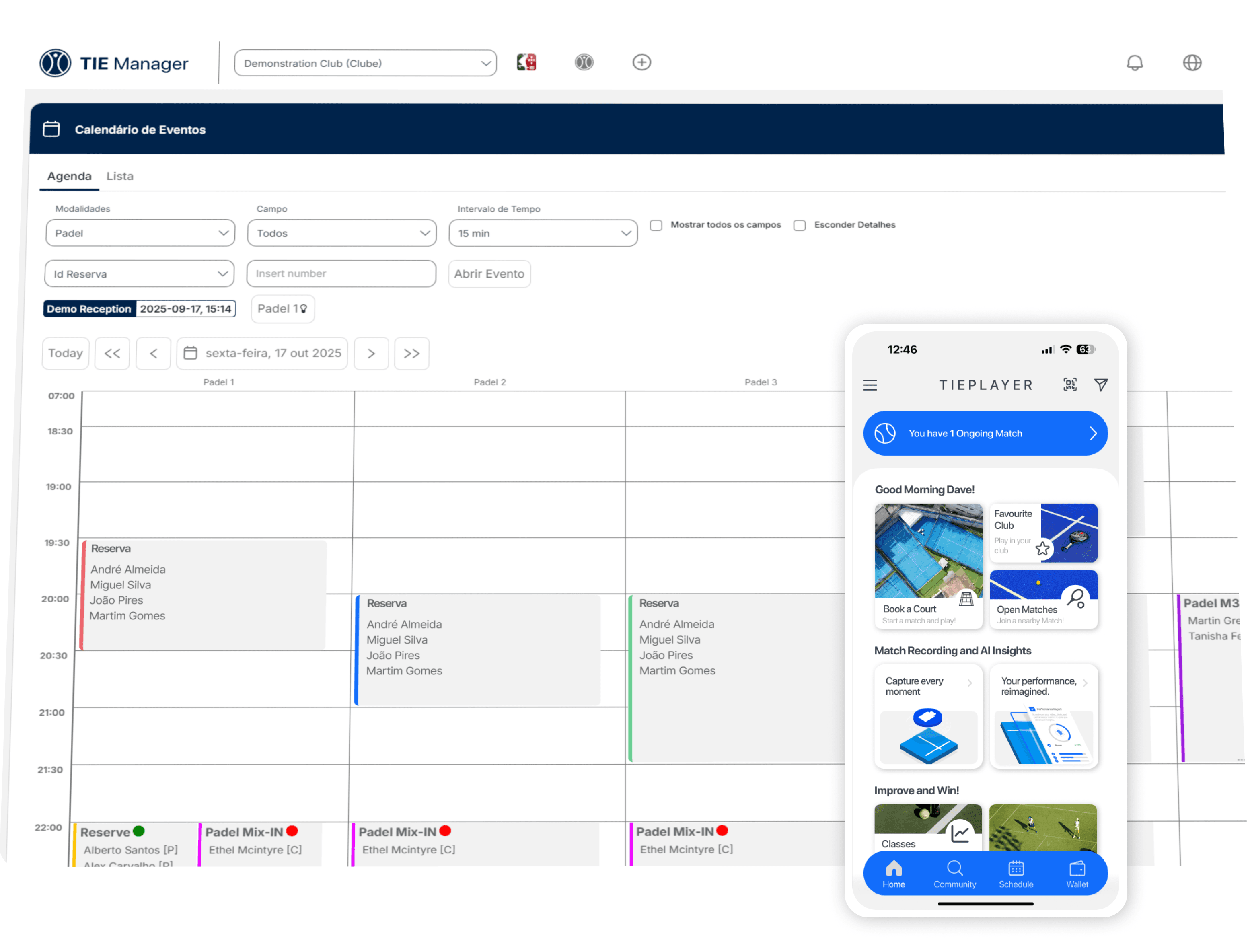
How to run a successful padel or tennis club in 2026

The complete guide to increasing court occupancy, streamlining operations and creating an experience that keeps players coming back
There was a time when running a padel or tennis club was relatively straightforward.
If the courts were well maintained, bookings were written into a diary, phone calls were answered promptly and lessons were organised efficiently, most of the job was done. Players expected little more than a place to play, and competition between clubs was limited.
That reality no longer exists.
The rapid growth of racquet sports has transformed not only the number of players entering the market, but also what those players expect from a club. Today, members compare clubs long before they step onto the court. They judge how easy it is to make a booking, how quickly they can pay, whether they can find opponents of a similar level, how efficiently the club communicates and how smooth the entire experience feels from beginning to the end.
For club managers, this growth has created an interesting paradox.
Demand has increased, creating new opportunities to generate revenue, but every new opportunity also brings additional complexity. Bookings, payments, cancellations, academy management, access control, lighting, tournaments, customer communication, retail sales, memberships and reporting have gradually become part of the same daily operation.
The question is no longer how to keep a club running.
The real challenge is how to grow the business without increasing administrative workload at the same pace.
Running a successful padel or tennis club in 2026 means finding the right balance between people and technology. Automation should remove repetitive tasks without removing the human touch. Data should support better decisions without turning management into a never-ending spreadsheet exercise. Communication should keep players engaged without overwhelming them with irrelevant messages.
At the centre of every successful club remains one simple idea. A club grows when it encourages more people to play, makes it easy for them to return and removes every unnecessary obstacle between the intention to play and the next booking.
Simple in theory. Far more challenging in practice.
The player experience starts long before players arrive
Many club owners naturally associate the customer experience with the moment a player walks through the front door.
In reality, the experience begins much earlier.
It starts when someone searches for somewhere to play after work. It continues while checking court availability, organising a group, selecting a time slot and completing the payment. Only afterwards do they experience the parking, reception, changing rooms, courts, coffee and coaching staff.
Every one of these moments influences whether a player decides to book again.
Imagine someone looking for a court at 6 p.m. They find your club online but need to call reception to check availability. Nobody answers immediately, so they leave a message. While waiting for a reply, they discover another club where they can view availability, book a court and pay within two minutes.
Your facilities might actually be better. Your location might even be more convenient. Yet the booking goes elsewhere. Not because your courts are worse. Because your booking process created friction.
Reducing friction has become one of the most important competitive advantages in modern club management.
Every additional phone call, manual confirmation or unnecessary step between the decision to play and the completed reservation increases the likelihood that a potential customer simply gives up.
This doesn't mean eliminating personal service.
Many players will always appreciate speaking to someone, particularly when organising events, booking lessons or dealing with unusual requests.
The goal is different. Players shouldn't need human assistance to complete tasks that technology can already handle efficiently.
Court bookings are no longer just a calendar
For years, booking software served one primary purpose: Preventing two groups from booking the same court at the same time.
Today, that definition feels remarkably outdated. A booking is no longer just a reservation. It represents the point where customer experience, revenue generation, operational efficiency and business intelligence all meet.
Every booking contains valuable information. Which time slots are consistently full? Which courts generate the highest revenue? How long does it take before a first-time visitor books again? Which customers play most frequently? Which hours remain underused every week?
The objective should therefore extend far beyond simply filling empty courts. Modern booking systems should remove friction, collect meaningful operational data and create additional revenue opportunities throughout the customer journey.
A player booking a court may also need racket hire, new balls, coaching, video recording services, refreshments or access to premium facilities.
If these purchases happen separately at reception, the club depends on staff availability and last-minute decisions.
When they become part of the booking journey itself, the experience becomes significantly smoother.
Players pay once. Everything is ready when they arrive. Reception spends less time processing transactions and more time welcoming customers.
Perhaps most importantly, the booking stops being the sale of ninety minutes on court. Instead, it becomes the beginning of a much broader customer experience.
The hidden cost of empty hours
A club that appears fully booked every evening can easily create the impression of operating at maximum capacity. Reality is often more complicated.
Many clubs experience outstanding occupancy between 6 p.m. and 9 p.m. while leaving courts almost empty during mornings, early afternoons or certain weekdays.
The challenge isn't necessarily attracting more players. It's distributing demand more effectively.
Lowering prices across the board often seems like the quickest solution. Unfortunately, it rarely becomes the smartest one. Discounting already popular time slots simply reduces revenue without solving the real problem.
Successful clubs take a different approach. Instead of asking how to sell cheaper, they ask who is most likely to play during quieter periods.
Remote workers, university students, retired players, shift workers or coaches. Each group has completely different availability. Treating them all as one audience inevitably produces generic communication.
Booking data allows clubs to identify these behavioural patterns. Managers can see who regularly plays during weekday mornings, who has stopped booking recently or who consistently prefers off-peak hours.
Once these trends become visible, promotions stop being generic campaigns and become highly relevant opportunities presented to the right people at the right time.
That distinction matters. Sending a targeted offer to someone genuinely interested in an available court solves a problem. Sending the same promotion to every contact in the database usually creates noise instead.
Sometimes the missing player is the real problem
Not every empty court exists because demand is low. Very often, three players are ready to play but cannot find a fourth. Others would happily join a match if they knew players of a similar standard.
Traditionally, clubs solve these situations through WhatsApp groups, personal contacts or staff intervention. Although this approach works, it consumes valuable staff time while depending heavily on personal networks.
Open Matches represent a different philosophy. Instead of waiting until a group is complete, players can publish available spaces and invite others to join. When player ratings or skill levels are included, participation becomes significantly more comfortable because uncertainty is reduced.
For clubs, the benefits go far beyond filling one empty court. Every new match introduces players to new partners, gradually expanding their social network inside the club.
The stronger those connections become, the less dependent players are on the availability of their original group. This changes the role of the club itself.
Successful clubs no longer simply provide courts. They actively help games happen.
Automation should never replace hospitality
Automation still makes some club owners uncomfortable. For many, it conjures up images of unmanned facilities, impersonal customer service and technology replacing people.
In reality, the opposite is true. Good automation doesn't reduce human interaction. It removes the repetitive tasks that prevent staff from delivering meaningful human interaction.
Opening doors. Switching court lights on and off. Sending access codes. Confirming payments. Reminding players about upcoming bookings. These are all necessary processes, but very few of them require someone to stop what they're doing every single time.
When repetitive work disappears, reception staff spend more time welcoming new members instead of answering routine phone calls.
Coaches spend less time dealing with paperwork and more time coaching. Managers stop solving operational issues all day and begin focusing on improving the business itself.
Automation also introduces something every successful club depends on: consistency.
Access codes are delivered on time. Court lighting follows the booking schedule automatically. Payments are confirmed immediately. Players know exactly what to expect before they even arrive.
That consistency becomes especially valuable for clubs operating extended opening hours or partially unattended facilities. Instead of increasing staffing costs every time operating hours expand, clubs can extend availability while maintaining the same level of service.
Of course, technology alone is never the solution. Poorly designed automation simply replaces one frustration with another.
Late access codes, confusing instructions or complicated booking journeys generate more support requests than they eliminate.
That's why every automated process should begin with one simple question: Does this make life easier for the player?
If the answer is yes, technology is doing its job. If not, the process probably needs redesigning. The best technology is almost invisible.
Players reserve a court, receive confirmation, access the facility and enjoy their game without ever thinking about the systems working in the background.
Every number tells a story
Perhaps the most revealing question a club owner can ask isn't: "How is the club doing?" It's this: "How do we actually know?"
At first glance, the difference seems insignificant. In reality, it completely changes how a business is managed.
Many decisions are still based on instinct. Reception feels busier. The courts looked full yesterday. The latest tournament attracted more players than expected.
Experience matters. Intuition matters. But neither should replace evidence.
Data allows managers to distinguish perception from reality. A club may appear exceptionally busy while still leaving hundreds of court hours unused every month.
New players may be joining every week while exactly the same number quietly disappear. Revenue may increase even as profitability declines because excessive discounting has become the default strategy.
Modern club management no longer depends solely on experience. It depends on the ability to understand what is actually happening inside the business. Fortunately, that doesn't require analysing dozens of complex reports every morning.
A handful of meaningful indicators often provide everything a manager needs. Court occupancy. Revenue per booking. Player retention. Repeat booking rates. Online reservations. Peak demand. Academy growth. These figures tell stories long before problems become visible.
An underused court may reveal an issue with scheduling rather than demand. Declining morning bookings might suggest a communication opportunity rather than a pricing problem. A growing junior academy could justify expanding coaching resources before competitors recognise the same trend.
Numbers stop becoming reports. They become conversations about the future.
Financial management is about more than collecting payments
For years, invoicing and payment processing were treated almost exclusively as administrative responsibilities. Necessary, important, but disconnected from the wider customer experience.
Today's players don't see it that way. People who purchase flights, order food, pay bills and shop online within seconds naturally expect the same simplicity when booking sports facilities.
They want confirmation immediately. They expect secure digital payments. They don't want to queue at reception simply to complete a transaction that could have happened beforehand.
For club managers, integrated financial processes deliver equally significant advantages. Bookings connect directly with payments. Retail sales become part of the same transaction. Financial records remain organised without additional reconciliation. Perhaps more importantly, revenue becomes predictable.
When payment occurs during the booking process rather than upon arrival, clubs gain far greater visibility over future income. Late cancellations decrease. Outstanding balances become less common. Cash flow improves.
For facilities carrying substantial costs - rent, utilities, maintenance, staffing and equipment - predictability often becomes just as valuable as growth itself.
The academy should never operate as a separate business
Many sports clubs unknowingly divide themselves into separate organisations.
Reception manages bookings. Coaches manage lessons. Administration manages invoicing. Parents communicate with whoever happens to answer first. Eventually, information becomes fragmented.
Processes are duplicated. Nobody has the complete picture. A modern academy should function as part of one connected ecosystem. Everything from the first enquiry through lesson scheduling, attendance tracking, communication and billing should follow one consistent process.
Parents shouldn't need multiple conversations simply to report an absence. Coaches shouldn't spend evenings updating spreadsheets instead of planning lessons. Administrative teams shouldn't manually calculate every timetable adjustment or temporary suspension.
Every hour spent on repetitive administration is an hour that could have been invested in improving the player experience. Integration doesn't simply reduce workload. It creates confidence.
Parents receive accurate information. Players enjoy better organisation. Coaches focus on development. Managers maintain complete visibility over academy performance without chasing information across different systems. The academy stops becoming an isolated department. It becomes one of the club's strongest long-term growth engines.
Communication is still one of the most underestimated competitive advantages
Here's an interesting exercise. Think about the last message a player received from your club. Was it genuinely useful? Or was it simply another payment reminder or tournament announcement?
Many clubs invest thousands of euros attracting new players while barely communicating with the people who already know the facilities, trust the coaches and are most likely to return. Effective communication isn't about sending more messages. It's about sending better ones.
A player who hasn't booked for six weeks may only need a gentle reminder. Someone who always plays Tuesday evenings might appreciate being notified when a regular slot becomes available. Parents of academy students expect completely different information from competitive adult players.
The more relevant the communication becomes, the less it feels like marketing. Instead, it becomes part of the service itself.
One of the biggest mistakes clubs continue to make is treating every customer exactly the same. But players are never in the same stage of their journey. Some have just discovered padel. Others play four times every week. Some are looking for coaching. Others simply want new opponents at their own level.
Recognising those differences fundamentally changes the way communication works. Players stop feeling targeted. They start feeling understood.
The most profitable marketing strategy might already be inside your database
Growth is often associated with advertising. Launch a Google Ads campaign. Boost a post on social media. Invest in paid acquisition. The logic seems obvious, and sometimes it's the right decision.
But before increasing the marketing budget, every club should ask itself one simple question. Are we making the most of the players we already know?
Most clubs have hundreds — sometimes thousands — of people who booked once and never returned. Others attended lessons for a few months before disappearing. Some stopped playing because of work, an injury or family commitments, but were never contacted again.
Winning those players back is almost always more cost-effective than acquiring completely new ones. The trust already exists. They know the facilities. They know the coaches. They've already experienced the club.
Often, all they need is a reason to come back. That reason doesn't always have to be a discount. Sometimes it's an Open Match. A social event. A beginner tournament. A coaching clinic. A new membership option. Or simply the right message delivered at the right moment.
This is where marketing and technology stop being separate disciplines. The better a club understands its players' habits, the more relevant every campaign becomes. Marketing stops being about broadcasting messages. It becomes about creating timely opportunities.
Great clubs don't sell courts, build Habits
There is an important difference between a satisfied customer and a loyal player. Satisfied customers enjoy their experience. Loyal players build that experience into their weekly routine.
Think about the player who books every Wednesday evening at 8 p.m. Eventually, they stop making a conscious decision every week. Playing becomes part of their lifestyle. That is exactly what successful clubs should aim to achieve.
The strongest clubs don't rely on constant promotions to keep courts busy. Instead, they create environments where returning feels natural. Weekly leagues. Community rankings. Open Matches. Internal competitions. Player challenges. Social events. Academy progression. Coach visibility. Club achievements.
None of these activities exist simply to fill a calendar. They strengthen relationships. And relationships create retention. People rarely leave communities where they feel they belong.
The future of club management isn't about working harder
For years, the image of a great club manager was someone who knew every player by name and personally solved every operational problem.
Experience still matters. Personal relationships still matter. But they are no longer enough on their own.
Today's clubs often serve hundreds or even thousands of active players. No manager can manually monitor every booking pattern, attendance trend or customer behaviour.
This is where data begins to create genuine competitive advantage. Not because it produces beautiful dashboards. Because it answers important questions.
Which players haven't returned recently? Which time slots are gradually losing occupancy? Which coaches retain students for the longest period? Which marketing campaigns actually generate bookings? Which additional services create the highest value? Every answer improves one small part of the business.
And dozens of small improvements eventually become a significant competitive advantage.
Artificial intelligence won't replace club managers. It will help the best ones grow faster
Artificial Intelligence is probably the most discussed technology in sport today. Like every major innovation, it generates both excitement and uncertainty.
Some people imagine fully automated clubs with almost no human interaction. The reality will almost certainly look very different.
Sports clubs will continue to need great coaches. Reception teams. Operations managers. Club directors. Technology won't replace them. It will simply reduce the number of repetitive decisions they need to make every day.
Imagine software capable of identifying players who are likely to stop attending. Or recommending the best moment to launch a tournament. Or suggesting promotions for underused court hours. Or predicting demand before it actually happens. None of these insights replace human judgement. They strengthen it.
Over the next decade, the biggest competitive advantage won't belong to the clubs with the most technology. It will belong to the clubs that use technology to create better experiences for their players.
Racquet sports in Portugal: What the data reveals
There is a significant difference between talking about the growth of padel and tennis and actually observing that growth through real-world data.
Many industry reports rely on estimates, surveys or limited research. While valuable, they only tell part of the story.
Digital platforms provide another perspective entirely. Every booking, tournament, match result and player interaction contributes to a broader understanding of how racquet sports continue to evolve.
Today, TiePlayer powers one of Portugal's largest racquet sports communities, offering valuable insights into player behaviour, club operations and the continued digital transformation of the industry.
The platform currently connects:
Metric | Value |
Partner clubs | 400+ |
Registered users | 450,000+ |
Bookable courts | 1,300+ |
Online court bookings | 1.5 million+ |
Tournaments organised | 20,000+ |
Match results recorded | 950,000+ |
Messages exchanged between players | 10 million+ |
These figures represent far more than the growth of a software platform. They illustrate how dramatically the relationship between clubs and players has changed.
Only a few years ago, organising a match often meant exchanging multiple phone calls or messages before finding an available court.
Today, millions of bookings are completed online, allowing clubs to reduce administrative work while giving players the ability to reserve a court in seconds.
The same transformation applies to tournament management, player communication, match tracking and finding new playing partners.
Processes that once depended almost entirely on manual coordination have become connected, immediate and scalable. More importantly, these interactions generate valuable operational insight.
By analysing thousands of bookings and player behaviours, clubs can better understand demand patterns, identify underused court hours, evaluate marketing initiatives and make informed business decisions.
This shift signals something much larger than digitalisation. It marks the transition from managing facilities to managing communities.
And as Artificial Intelligence, predictive analytics and automation continue to evolve, clubs that understand and use their data effectively will increasingly outperform those relying solely on instinct.
Final thoughts
Running a successful padel or tennis club in 2026 is no longer just about maintaining great facilities or organising tournaments.
It means building an operation capable of growing consistently while delivering a seamless experience for both players and staff.
The clubs that will lead the industry over the next decade are unlikely to be those with the newest buildings or the biggest advertising budgets.
They will be the ones that understand their players better than anyone else. They will make decisions based on evidence rather than assumptions. They will automate repetitive work without losing the personal touch. They will communicate with relevance instead of volume. Most importantly, they will create communities that players genuinely want to be part of.
Because, in the end, successful clubs don't simply provide courts. They create places where people choose to return, week after week.
Frequently asked questions
How can a padel or tennis club increase court occupancy?
The most effective strategy combines frictionless online booking, targeted communication, dynamic scheduling and initiatives that help players find opponents of a similar level. Increasing occupancy isn't just about attracting new customers—it's about making better use of your existing player base.
What are the most important KPIs for managing a sports club?
Key performance indicators include court occupancy, revenue per booking, player retention, repeat booking rate, academy growth, cancellation rate and online booking adoption. Together, these metrics provide a clear picture of operational performance and long-term sustainability.
Is automation worthwhile for smaller clubs?
Absolutely. Automation benefits clubs of every size by reducing repetitive administrative work, improving operational consistency and delivering a better experience for players without requiring additional staff.
How do clubs improve player retention?
Retention comes from creating consistently positive experiences. Easy booking, personalised communication, community activities, coaching programmes and opportunities to meet players of a similar level all contribute to long-term loyalty.
What should modern club management software include?
A modern platform should integrate court bookings, online payments, invoicing, academy management, customer communication, reporting, automation and player engagement within a single ecosystem. The fewer disconnected tools a club relies on, the more efficiently it can operate.